
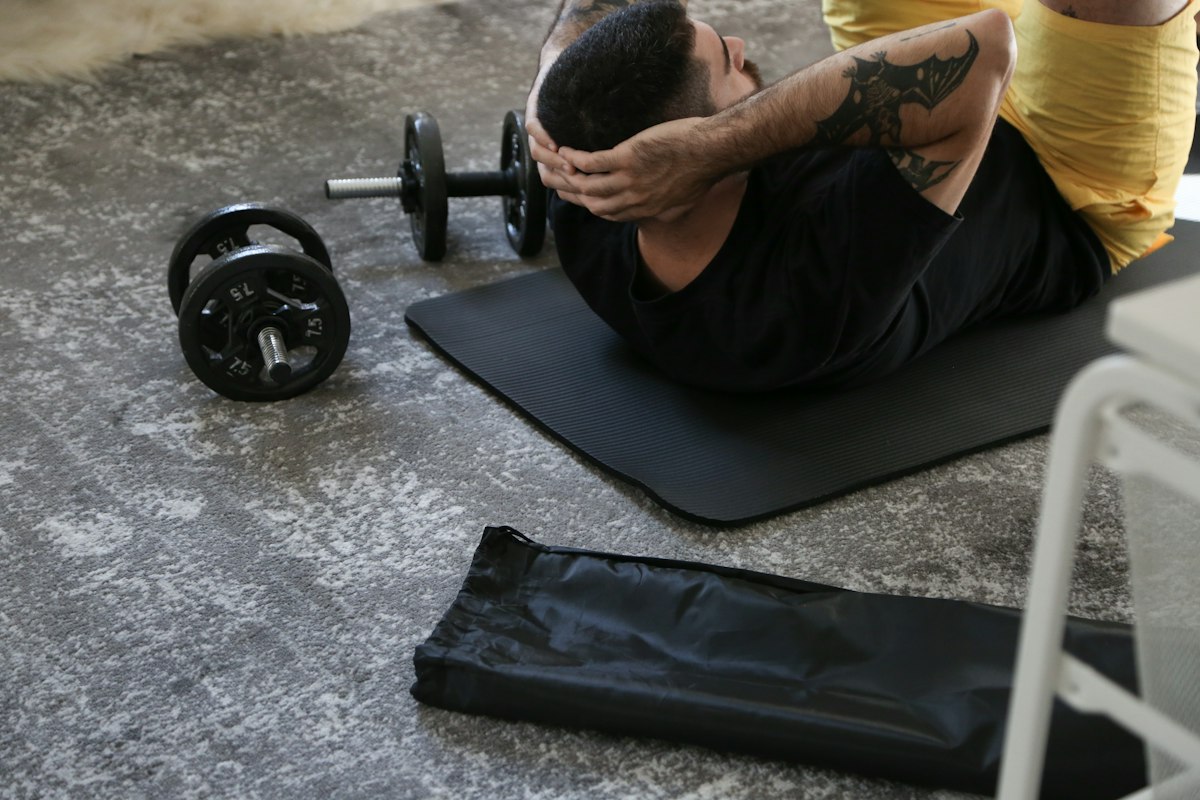
Every guy who's ever done a hundred crunches a day and still not seen abs has run into the same wall: ab visibility isn't primarily about the muscle itself. It's about what's covering it.
Your Abs Are Already There
Here's the thing nobody wants to hear: if you have a functioning core, you already have ab muscles — everyone does, they're a normal part of human anatomy. Whether you can see them has far more to do with the layer of subcutaneous fat sitting on top of them than with how many ab exercises you've done. Training your abs makes them stronger and can add some thickness, but no amount of ab-specific training will make them visible if there's still a meaningful fat layer covering them — a direct application of the fact that spot reduction of fat doesn't work (see our earlier post on that exact myth).
The Body Fat Percentage Reality
Across fitness and body composition sources, the consistent range cited for visible, defined abs in men is roughly 6-12% body fat, with the outline of abs sometimes becoming visible in the 13-15% range depending on individual muscle thickness and where someone naturally stores fat. This is meaningfully leaner than the average adult male, which is exactly why visible abs read as a marker of significant leanness rather than just "in decent shape."
For context, standard body fat categorization (widely used by organizations like the American Council on Exercise) generally places essential fat for men around 2-5%, athletes around 6-13%, fitness-level around 14-17%, and average in the high teens to mid-20s. Visible abs sit right at the boundary between "athlete" and elite leanness — which is exactly why it's genuinely hard to achieve and maintain, not a simple product of "working harder."
Why Going Too Low Isn't Actually a Good Goal
Here's the part that gets skipped in most "how to get abs" content: going below essential fat levels, or staying at extremely low body fat for extended periods, carries real health costs. Very low body fat has been linked to hormonal disruption, reduced energy availability, and impaired bone health — issues traditionally discussed more in relation to female athletes, but that also apply to men pushing body fat extremely low for extended periods. Competition-level leanness (the kind seen in bodybuilding shows) is generally understood to be unsustainable and inappropriate to maintain long-term, precisely because of these costs.
Most people, the research and clinical guidance suggests, genuinely feel and perform better sitting slightly above the leanest look they could technically achieve — a useful thing to know before chasing single-digit body fat as a lifestyle rather than a short-term goal.
What Actually Gets You There
Since spot reduction doesn't work and ab-specific training doesn't strip fat off your midsection, visible abs come down to the same fundamentals covered in body composition research generally:
- A sustained, moderate calorie deficit to bring down overall body fat — there's no way around this part.
- Resistance training, including but not limited to ab work, to build and maintain the muscle that will actually show once the fat comes down.
- Adequate protein to preserve muscle mass while in a deficit, so what becomes visible is defined muscle, not just a smaller, less muscular midsection.
- Patience with the specific body fat range required — getting from "in good shape" to "visible abs" is a jump of several more percentage points of body fat than most people expect, and it gets progressively harder to lose each additional pound the leaner you get.
The Takeaway
Visible abs are mostly a body fat percentage story, not an ab-training story — and the percentage required (roughly 6-12% for men) is genuinely lean, at the edge of what's healthy to maintain long-term. Understanding that going in helps set a realistic goal, rather than chasing an ab routine that was never going to be the limiting factor in the first place.
References
- American Council on Exercise (ACE) body fat percentage categorization standards for men (essential, athlete, fitness, acceptable, obese ranges).
- Body composition and health risks associated with very low body fat levels — general sports medicine and exercise physiology literature on energy availability and hormonal function at low body fat.
Keep Reading
Steroids and SARMs: The Health Risks the Research Has Documented
Read More →
Natural Muscle-Building Limits: How Much Muscle Can You Realistically Gain
Read More →
Discussion