
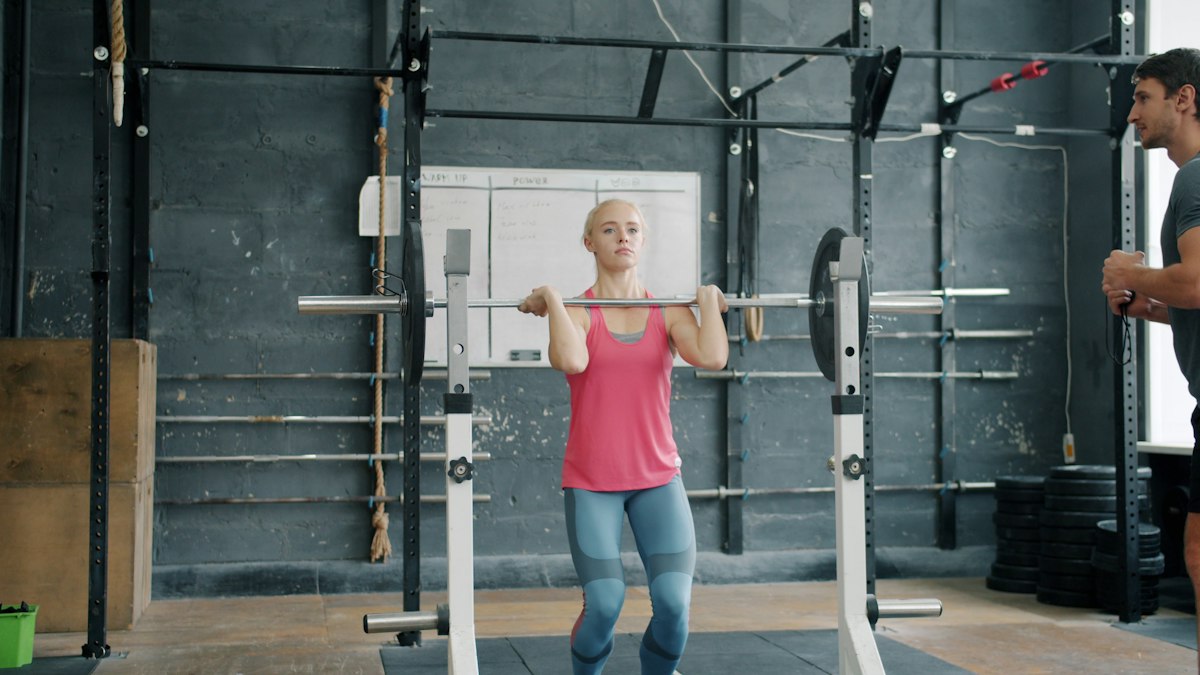
I had a client — let's call her Jess — show up to her first session with a pair of 3-pound pink dumbbells she'd bought on her own. When I asked why, she said, "I don't want to get bulky, so I'm just doing high reps with light weight to tone." I hear a version of this almost every week from new female clients. And every time, I have to break the news gently: there is no such thing as a separate "toning" mechanism in the human body. Muscle does one of three things in response to training — it grows, it stays the same, or it shrinks. That's it. Your muscle doesn't know your gender and doesn't have a secret "lean and defined" setting that only activates at 20+ reps.
Here's the thing — I'm not saying this because I think heavy lifting is trendy. I'm saying it because that's what the research actually shows, and I don't coach on bro science. So let's get into what the studies say about rep ranges, and how you should actually be picking yours.
The "Toning" Myth Doesn't Hold Up to Science
The "toning" idea assumes women's muscle tissue responds to resistance training differently than men's — that light weight and high reps carve out a lean, defined shape while heavier weight bulks you up. Physiologically, that's not how it works. A 2020 systematic review and meta-analysis in the Journal of Strength and Conditioning Research directly compared relative strength and hypertrophy adaptations between men and women and found no meaningful sex-based differences in how muscle responds to training stimulus (Roberts et al., 2020). Muscle fibers hypertrophy through the same mechanical tension, metabolic stress, and muscle damage pathways in everyone who has them.
What actually determines whether you build visible muscle isn't your sex — it's your training stimulus, your nutrition, and your hormonal environment. Most women simply don't carry the testosterone levels needed to put on muscle at the rate men do, which is exactly why "getting bulky by accident" from lifting a barbell is not something you need to worry about. What lifting heavier actually does is give you a stronger, more defined physique — the "toned" look most of my female clients are chasing in the first place.
What the Research Actually Says About Rep Ranges
Brad Schoenfeld and colleagues have done more to map out the "repetition continuum" than almost anyone in exercise science. Their 2021 re-examination published in Sports pulled together the existing evidence and found that muscle growth happens across a surprisingly wide range of loads — essentially anywhere from about 30% of your one-rep max up through heavy loads — as long as sets are taken close to failure (Schoenfeld et al., 2021). Translation: you don't need to live in one "hypertrophy zone" to build muscle. Low reps with heavy weight and higher reps with lighter weight can produce similar muscle growth, provided the effort is there.
Strength is a different story. An earlier meta-analysis by the same research group compared low-load, high-rep training against high-load, low-rep training head-to-head and found that while both built comparable muscle size, heavier loads produced significantly greater gains in maximal strength — your actual one-rep max (Schoenfeld et al., 2017). So rep range doesn't change much for "can I build muscle," but it changes a lot for "how strong can I get."
Training for Strength: Why Heavier and Lower Reps Win
If your goal is to get genuinely stronger — lifting heavier on your squat, deadlift, or bench, or just being able to move your own body and your kids around with ease — you need to spend real time in the lower rep ranges. I program most of my strength-focused clients in the 3-6 rep range for main lifts, using loads around 80-90% of their one-rep max. This is where the nervous system adaptations that drive strength — better motor unit recruitment, improved coordination, more efficient firing patterns — get trained most directly.
This doesn't mean you're only ever doing heavy singles. A well-rounded strength block still includes some moderate-rep work (think 6-10 reps) for building the muscular foundation that supports those heavier lifts. But if strength is the primary goal, the bulk of your working sets need to be heavy enough that you genuinely couldn't do more than 6 or so clean reps.
Training for a Leaner, More Defined Look: Picking Your Rep Range
If your goal is more about body composition — building visible muscle shape while leaning out — the good news from the research above is that you have flexibility. A moderate rep range of about 8-15 reps per set, training close to failure, tends to be the sweet spot I use most with my female clients chasing a leaner, more defined physique. It builds meaningful muscle, it's sustainable on the joints, and it leaves enough gas in the tank to train with high frequency and consistency — which matters more long-term than which exact rep number you picked.
Here's what I actually tell clients like Jess: mix it up. Spend some blocks closer to 6-8 reps with heavier weight to build strength and muscle, and other phases in the 10-15 rep range to accumulate volume and work on muscular endurance. The real lever for a "toned" look isn't the rep count — it's progressive overload (consistently challenging the muscle more over time) combined with a nutrition plan that reveals the muscle you've built. A broader meta-analysis on resistance training in women backs this up: both strength and hypertrophy improved substantially regardless of specific loading schemes, with consistency and progressive challenge mattering more than any single magic rep number (Hagstrom et al., 2020).
The Takeaway
There's no special "toning" rep range reserved for women, and there's no rep range that will accidentally turn you into a bodybuilder overnight. Your muscle responds to training stimulus the same way everyone's does — heavier loads and lower reps build more raw strength, moderate reps taken close to failure build muscle just as effectively, and the "shape" you're after comes from a combination of the muscle you build and the body fat you reveal. Pick your rep range based on your actual goal — strength or a leaner, more defined look — not based on outdated gym folklore about staying "light and toned." Put down the 3-pound dumbbells when you're ready, Jess. Your muscles can handle more than you think.
References
- Roberts, B. M., Nuckols, G., & Krieger, J. W. (2020). Sex Differences in Resistance Training: A Systematic Review and Meta-Analysis. Journal of Strength and Conditioning Research, 34(5), 1448–1460.
- Schoenfeld, B. J., Grgic, J., Van Every, D. W., & Plotkin, D. L. (2021). Loading Recommendations for Muscle Strength, Hypertrophy, and Local Endurance: A Re-Examination of the Repetition Continuum. Sports, 9(2), 32.
- Schoenfeld, B. J., Grgic, J., Ogborn, D., & Krieger, J. W. (2017). Strength and Hypertrophy Adaptations Between Low- vs. High-Load Resistance Training: A Systematic Review and Meta-analysis. Journal of Strength and Conditioning Research, 31(12), 3508–3523.
- Hagstrom, A. D., Marshall, P. W., Halaki, M., & Hackett, D. A. (2020). The Effect of Resistance Training in Women on Dynamic Strength and Muscular Hypertrophy: A Systematic Review with Meta-analysis. Sports Medicine, 50(6), 1075–1093.
Keep Reading
Best Rep Ranges for Building Strength vs. Building Size
Read More →
Toning vs. Bulking: The Physiology of Women's Muscle Response to Training
Read More →
Discussion