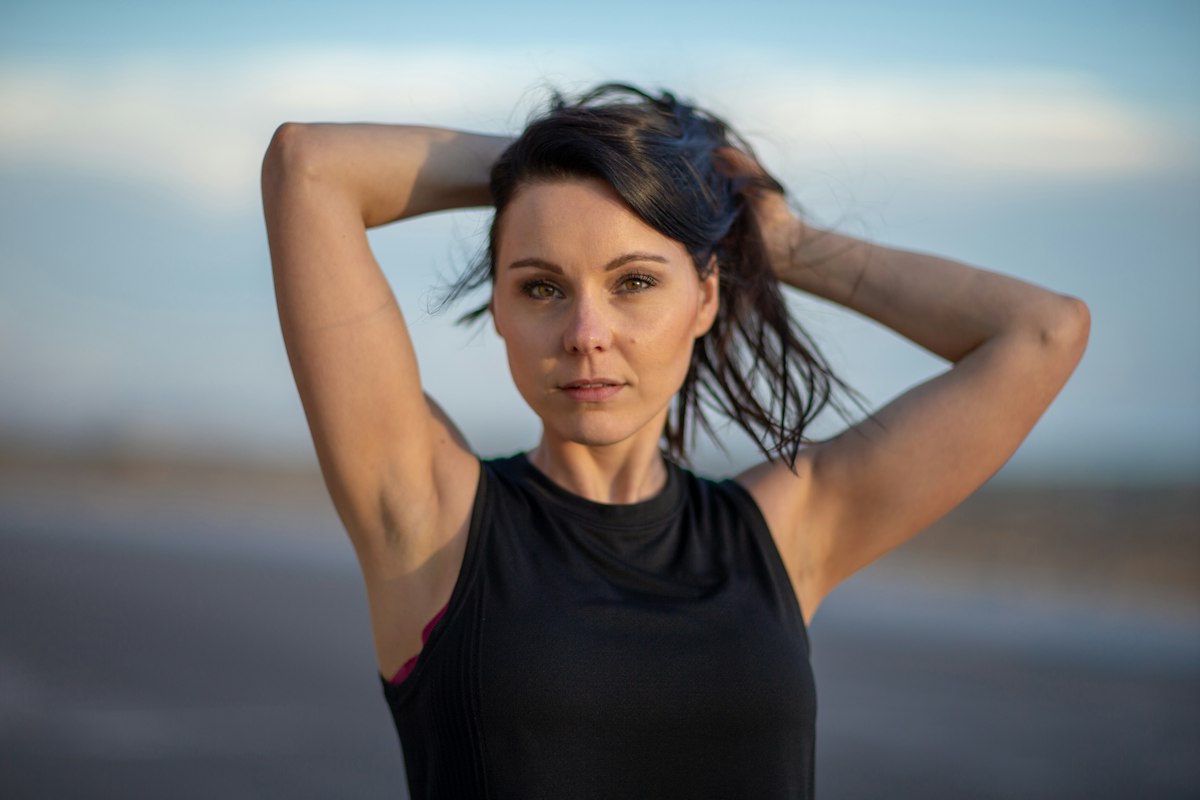
I can't tell you how many times a woman in her 40s has sat across from me — sometimes in tears — telling me she's doing everything right. Same workouts that always worked. Same eating habits. And the scale is still climbing, especially around her stomach. The first thing I tell her is this: you're not losing your mind, and you're not lazy. Something real is happening in your body, and it has a name — perimenopause.
Here's the problem. Walk into any corner of the internet and you'll find two extremes. One camp tells women "it's all hormones, nothing you can do, just suffer through it." The other camp says "hormones are an excuse, just eat less." Both are wrong, and both are bro science dressed up in different outfits. Let's actually look at what the research says.
Your Hormones Really Do Change How Your Body Stores Fat
Let's start with the part that's real, because women get gaslit about this constantly. A major review published in the journal Climacteric by Davis and colleagues (2012) looked at the evidence and found something important: the slow, steady weight gain most people experience in midlife — roughly a pound a year — is mostly driven by aging, not menopause itself. But here's the part that matters for you: the hormonal shift at menopause is independently linked to an increase in total body fat and, specifically, abdominal fat. Your body literally starts redistributing fat differently, shifting from a "pear" pattern to more of an "apple" pattern around your midsection. That's not you failing. That's declining estrogen changing where your body wants to park fat.
So when a client tells me "I'm doing the exact same thing I did five years ago and my body looks different," I believe her. Her hormones changed. Her body's default settings changed. That's fact, not myth.
The Muscle Loss Is the Part Nobody Warns You About
This next one is, in my opinion, the single most underrated finding in this whole conversation. Researchers from the Study of Women's Health Across the Nation (SWAN) — Greendale and colleagues, published in JCI Insight (2019) — tracked women's body composition year by year through the menopause transition. What they found should be required reading for every woman over 40. Right around the start of the transition, the rate of fat gain roughly doubled. At the exact same time, lean mass — your muscle — stopped increasing and started declining.
Here's the sneaky part. Total body weight and BMI kept climbing at the same steady pace the whole time, before and during the transition. The scale didn't show any dramatic jump. But underneath that number, the composition of your body was quietly getting worse — more fat, less muscle — even though the scale looked "normal." This is exactly why I tell my clients to stop obsessing over the scale during this stage of life. The scale can be lying to you about what's actually happening to your body.
Why This Isn't Just About Looks — Muscle Is Your Metabolic Engine
I want you to understand why that muscle loss matters beyond how your clothes fit. Muscle is metabolically active tissue — it's a big part of what determines how many calories your body burns just existing. When you lose muscle and gain fat at the same time, your metabolism takes a hit from both directions. Less muscle means fewer calories burned at rest. More fat, especially visceral fat around your organs, is linked to worse metabolic health overall. That combination is exactly why so many women tell me "I eat less than I ever have and I still can't lose weight." It's not in your head. Your engine genuinely changed.
What the Research Actually Shows Helps
Now for the part I care about most, because this is where you get your power back. This is not a hopeless situation.
A 12-week randomized controlled trial by Ioannidou and colleagues (2024), published in The Journal of Nutrition, Health and Aging, put postmenopausal women into four groups: resistance training plus a high-protein diet, resistance training alone, high protein alone, and a control group doing neither. The results were clear. The groups doing resistance training gained real muscle mass — over a kilogram in just 12 weeks — and got meaningfully stronger. The protein-only group, with no training, built no muscle at all. Protein without lifting didn't move the needle. Lifting was the non-negotiable ingredient.
That same Climacteric review I mentioned earlier backs this up from a different angle — it points to roughly 60 minutes a day of moderate activity as essential for maintaining a healthy weight through this stage of life, with the combination of exercise and smart eating habits outperforming either one alone.
So here's what this means for you, practically: this is not the season of your life to cut your training back or go on another crash diet. This is the season to lift weights, consistently, two to three times a week minimum, and to eat enough protein to actually support the muscle you're working to keep. Walking and cardio are great for your heart and your stress levels, but they are not what's going to protect your muscle mass through this transition. Resistance training is doing a job here that nothing else can replace.
The Takeaway
Perimenopause is not an excuse, and it's not a myth. It's a real, measurable shift in how your body stores fat and holds onto muscle, driven by hormones that are genuinely out of your control. What IS in your control is how you respond to it. The data is consistent on this: resistance training is the single most powerful tool you have to protect your muscle, support your metabolism, and push back against the fat redistribution that comes with this stage of life. I'm not going to tell you it's as simple as it was in your 20s — it's not. But "harder" doesn't mean "hopeless." Pick up the weights. Eat enough protein to support what you're building. Give yourself grace about the scale, and pay attention to how your clothes fit and how strong you feel instead. That's the version of this story that's actually true.
References
- Davis, S. R., Castelo-Branco, C., Chedraui, P., Lumsden, M. A., Nappi, R. E., Shah, D., & Villaseca, P. (2012). Understanding weight gain at menopause. Climacteric, 15(5), 419-429.
- Greendale, G. A., Sternfeld, B., Huang, M., Han, W., Karvonen-Gutierrez, C., Ruppert, K., Cauley, J. A., Finkelstein, J. S., Jiang, S. F., & Karlamangla, A. S. (2019). Changes in body composition and weight during the menopause transition. JCI Insight, 4(5), e124865.
- Ioannidou, P., Dóró, Z., Schalla, J., Wätjen, W., Diel, P., & Isenmann, E. (2024). Analysis of combinatory effects of free weight resistance training and a high-protein diet on body composition and strength capacity in postmenopausal women - A 12-week randomized controlled trial. The Journal of Nutrition, Health and Aging, 28(10), 100349.


Discussion